LLM Ad Examples: 7 Real Campaigns Running Inside ChatGPT, Gemini, and Copilot Right Now
An LLM advertisement is a sponsored placement that appears inside the direct response of an AI assistant, shown to a user mid-query rather than alongside a webpage or above organic search results.
If you want to see what's actually running in 2026, here it is: sponsored product cards in shopping queries, in-answer text placements during research questions, and AI Overview sponsorships triggered by commercial-intent searches. These formats break the mold of display or search ads. The user isn't scanning a results page. They asked a direct question and are reading the answer. Your ad appears inside that answer.
The commercial intent in that moment is real. The user asked "which project management tool handles ISO compliance" or "best protein powder for endurance athletes." They want a recommendation. That's the inventory these platforms are selling.
Understanding how these placements work, how they're triggered, and what you can actually measure separates operators who get hard ROI from those guessing at attribution. AI assistants as a new ad inventory layer covers the structural shift in detail. This article focuses on what the ads themselves look like.
What LLM Ads Actually Look Like: Format Breakdown
LLM ads appear in three primary formats: inline text sponsorships woven into the assistant's answer, product cards with image and price data surfaced in shopping queries, and sourced citations where a sponsored result is labeled and linked within a list of recommendations.
Inline text sponsorships sit inside the prose of an answer. The assistant might recommend three tools; one of those slots is sponsored. The label "sponsored" or "ad" typically appears adjacent to the placement, but the copy reads as part of the response rather than beside it.
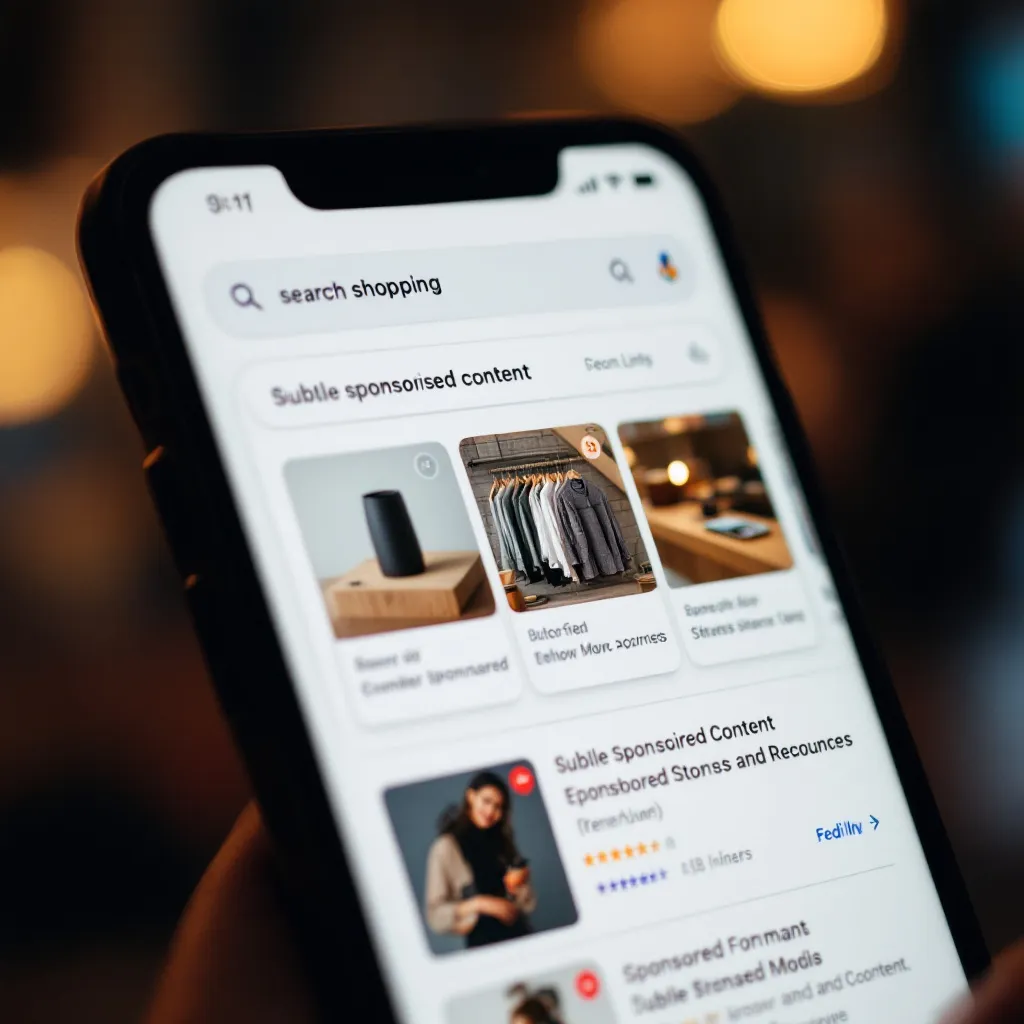
Product cards are richer. In observed placements, these include a product image, price, rating, and a direct purchase link. They appear in response to queries with clear commercial intent: "best standing desk under $800" or "noise-canceling headphones for open offices." These aren't advertisement banners in the traditional sense. A banner is a passive visual unit placed around content. A product card inside an assistant answer is embedded inside the content itself, shown to someone who is actively seeking a recommendation.
Sourced citation ads are the subtlest format. The assistant lists several sources or references; one is a paid placement, disclosed as sponsored. This format is common in research-heavy queries and review-style questions.
Each format demands different creative thinking. Banners tolerate passive creative because users scroll past them. LLM ad formats sit inside an active answer. The copy must match the query intent and the surrounding language of the response, or it reads as out of place and gets ignored.
ChatGPT Ad Examples: Sponsored Answers Inside Shopping and Research Queries
ChatGPT ad placements appear most visibly in shopping and research queries, where the assistant generates a structured recommendation and one or more positions within that structure are sponsored.
A concrete example: someone asks ChatGPT to recommend accounting software for a 10-person professional services firm. The assistant returns a structured answer with three or four options. One option, clearly labeled as sponsored, includes a short description written by the advertiser, a link to a landing page, and a brief note on pricing. The user is mid-decision. They're not browsing. They asked a direct question, and the placement appears in the answer to that question.
Another scenario: a user asks ChatGPT to compare CRM platforms for a sales team of 20. The sponsored placement appears as the first or second recommendation, labeled clearly. The copy is short, specific to the use case mentioned in the query, and links to a page with a free trial or a demo request form. Attribution works through UTM parameters appended to the landing page URL, tied to a dedicated ad account. You trace which query triggered the click, which placement it came from, and whether the user converted. That traceability is what makes the channel measurable rather than speculative.
What you cannot do at this stage is control creative at the individual query level in real time. The copy you submit gets matched to relevant queries by the platform. You set the parameters; the match happens algorithmically. Understanding that boundary matters before you build your first campaign.
ChatGPT shopping assistant ads for B2B software covers the B2B angle in detail, including how to structure your product feed for assistant-style queries.
Gemini Ad Examples: Product Cards and AI Overview Placements
Gemini surfaces ad placements in two distinct contexts: product cards inside shopping queries and sponsored slots within AI Overview answers shown at the top of Google Search results.
Product cards in Gemini shopping responses aren't advertisement banners. A banner is a visual interrupt placed around a page. A Gemini product card appears inside a direct answer to a purchase-intent query, typically including product image, price, retailer, and a link. The creative requirements are driven by your product feed, not by a display designer. Title accuracy, price freshness, and image quality matter far more than visual creativity.
AI Overview placements work differently. These appear when Gemini generates a summarized answer at the top of a search results page for a commercial query. A sponsored result can appear within or adjacent to that generated answer, labeled clearly. The trigger is the query's commercial intent rather than a keyword bid in the traditional sense.
Large consumer brands, including FMCG companies testing AI placements, have been active in both formats since the placements became broadly available. The strategy makes sense for brands with high product SKU counts and existing Google Shopping feeds, because the feed infrastructure maps directly onto product card eligibility.
For retail brands specifically, feed hygiene is the operational priority. Stale prices or mismatched product titles reduce placement eligibility. Gemini ads best practices for retail brands covers the feed requirements in depth. If you want to understand how Gemini pulls brand mentions into generated answers more broadly, getting your brand into Google AI Overview answers is the right starting point.
Copilot Ad Examples: Bing-Backed Placements Inside Microsoft's AI Assistant
Copilot ad placements run through Microsoft Advertising infrastructure, which means if you already run Bing search campaigns, the operational continuity is direct. The same account, the same billing, the same reporting dashboard.
In practice, Copilot ads appear when a user interacts with Microsoft's AI assistant on Windows, in Edge, or through Bing, and the query has commercial intent. A user asks Copilot to recommend project management tools for a construction company. A sponsored result appears within the assistant's answer, labeled as an ad, with a short description and a link.
The Microsoft Advertising connection matters for one specific operational reason: you're not building a new account from scratch. Your existing campaigns can be extended to Copilot placements with configuration changes rather than a full rebuild. Audience targeting parameters from your Bing campaigns carry over. Spend reporting is consolidated. That's a concrete advantage for operators who want to test a new channel without creating a parallel operational stack.
What Copilot doesn't offer at this stage is the same volume of consumer queries that ChatGPT or Google Gemini handles. The audience skews toward business users and Windows device owners. For B2B SaaS, enterprise software, and productivity tools, that skew is often an asset rather than a limitation. Copilot ads for SaaS lead generation covers how to configure targeting and match types for that audience.
Keep creative copy concise. Copilot answers tend to be structured and factual. Copy that mirrors that register sits more naturally inside the response.
LLM Ad Platform Comparison: Format, Trigger, and Attribution Side by Side
Choosing between ChatGPT, Gemini, and Copilot placements is easier with the right comparison frame. The question isn't which platform is better. The question is which format matches your query type, your vertical, and your attribution requirements.
| Platform | Ad Format | Query Trigger Type | Attribution Mechanism | Spending Control | Best Fit Vertical |
|---|---|---|---|---|---|
| ChatGPT | Inline text sponsorship, product recommendation slots | Shopping queries, research and comparison queries | UTM parameters, dedicated ad account reporting | Hard spending caps set at account level | B2B software, SaaS, consumer products with research cycle |
| Gemini | Product cards (shopping), AI Overview sponsored slots | Commercial-intent searches, product queries | Google Ads conversion tracking, feed-based attribution | Campaign budget controls via Google Ads | Retail, ecommerce, FMCG, high-SKU brands |
| Copilot | Inline sponsored recommendations | Business and productivity queries, Bing-adjacent commercial queries | Microsoft Advertising reporting, existing campaign data | Hard budget caps via Microsoft Advertising | B2B SaaS, enterprise tools, productivity software |
A few observations from this comparison. Gemini is most accessible for brands already running Google Shopping because the feed infrastructure transfers directly. Copilot is most efficient for teams already inside the Microsoft Advertising ecosystem. ChatGPT placements require the most deliberate copy work because the inline format sits closest to the assistant's own prose.
For placements beyond these three platforms, product recommendations in Perplexity AI search results covers how Perplexity handles sponsored citations differently.
What Makes a Good LLM Ad: Copy, Structure, and Intent Matching

A good LLM ad matches the register of the assistant's answer and the specific intent of the triggering query. That's the core requirement. Everything else follows from it.
This isn't how broadcast commercials work. A television spot is designed to interrupt and create attention in a passive viewer. LLM ads appear to someone who's already engaged, already reading, already seeking a recommendation. Interruption creative doesn't work here. Copy that sounds like an ad in a passive broadcast context reads as foreign inside an assistant answer.
In observed best practice, effective LLM ad copy does three things. First, it names the use case directly. "For teams managing ISO 27001 compliance workflows" is more effective than "for all business sizes." Second, it states one concrete differentiator, whether that's price, a specific feature, or a supported integration. Third, it ends with a clear next step: a free trial, a demo, or a specific landing page that continues the intent the user already expressed.
Structure matters too. Short sentences work better than dense paragraphs inside assistant responses. The assistant formats its own output in digestible chunks; your copy should match that rhythm.
What you shouldn't do is repurpose display copy or brand awareness creative without rewriting. The intent mismatch will cost you the click regardless of placement quality.
The GEA framework for product visibility in LLMs provides a structured method for thinking about how product copy gets surfaced inside LLM responses, both paid and organic.
Measuring LLM Ads: Attribution, Spending Caps, and What You Can Actually Trace
Attribution in LLM ads is measurable, but not complete. You need to know what you can trace and where the gaps are before you commit budget.
What you can trace: clicks from a sponsored placement to a landing page via UTM parameters, conversions on that landing page using standard tracking, and spend against those conversions at the ad account level. If you're running through a dedicated ad account with hard spending caps, you also have a clear ceiling on exposure during the test period. That matters when you're evaluating a channel you haven't run before.
What you can't fully trace yet: impression-level data showing exactly which query triggered a placement and what the full response looked like when your ad appeared. The assistant's answer is dynamically generated. The platform records the placement event, but the surrounding context of each answer isn't always exportable in granular form.
Spending caps aren't a comfort feature. They're a precision instrument for new channel testing. If you set a hard cap of $3,000 for a 30-day ChatGPT placement test, you get clean data on cost-per-click and cost-per-conversion against a known spend ceiling. You can then compare that against your existing paid search ROAS with a controlled denominator. Without a hard cap, spend can drift and your comparison becomes unreliable.
The channel's measurement infrastructure is still maturing. That's an honest assessment. But the mechanics available today—UTM tracking, dedicated accounts, hard caps, conversion tracking—are sufficient to run a disciplined test and reach a defensible decision about whether to scale.
Frequently Asked Questions About LLM Ad Examples
Are LLM ads available to small businesses or only enterprise advertisers?
In most cases, LLM ad placements are available to advertisers of any size, provided they meet the platform's minimum account requirements. ChatGPT and Copilot placements typically don't require enterprise contracts. Gemini product card placements are accessible through standard Google Ads accounts with an active Shopping feed.
How do LLM ad examples differ from traditional banner advertisements?
A banner advertisement is a passive visual unit placed around or beside page content, shown to users regardless of their query. An LLM ad appears inside an assistant's direct answer to a specific question, shown to a user who is actively seeking a recommendation. The context, intent level, and creative requirements are fundamentally different.
Can I run the same creative I use for Google Search in ChatGPT or Copilot?
Not without rewriting it. Search ad copy is optimized for a headline-and-description format scanned in a results list. LLM ad copy sits inside prose and must match the register of the assistant's response. Copy that sounds like a headline in a search context reads as an interrupt inside an assistant answer.
What budget should I start with to test LLM ads?
There's no universal minimum, and platform requirements vary. Practically, a test budget that gives you enough clicks to reach statistical significance on your conversion metric is the right floor. Set a hard spending cap before the test starts so your comparison data has a clean denominator.
How do I know if my ad appeared inside an AI assistant response?
Your dedicated ad account shows impression and click data for placements. UTM parameters on your landing page URLs let you confirm traffic source at the session level. Full query-level transparency varies by platform; in most cases you see aggregate placement data rather than a verbatim log of every assistant response where your ad appeared.
What's the typical cost-per-click for LLM ads versus search ads?
LLM CPCs vary significantly by vertical and query intent. B2B software placements typically run higher than consumer product queries. Direct comparison to search CPCs is difficult because the placement context and user intent differ materially. The right metric is cost-per-conversion or ROAS against your specific vertical baseline.
Can I use dynamic creative or automated bidding with LLM ads?
Limited automation exists across current platforms. ChatGPT requires manual copy submission matched to query types. Copilot integrates with existing Microsoft Advertising automation but with less granularity than search. Gemini leverages Google's Smart Bidding, though its application to AI Overview placements is still developing.
The State of LLM Ads Right Now: What to Do Next
LLM advertising is a measurable, accessible channel in 2026, not a future possibility. ChatGPT, Gemini, and Copilot all offer paid placements with attribution mechanisms that experienced paid media operators can work with today.
The advertisement examples covered in this article share two non-negotiable starting conditions: a dedicated ad account that keeps LLM spend separate from your existing campaigns, and hard spending caps that give your test a clean cost ceiling. Without those two elements, you can't reach a defensible conclusion about whether the channel works for your business.
Acknowledge the measurement gap honestly. Impression-level transparency and query-level reporting are still developing. What exists today—UTM tracking, conversion data, account-level spend reporting—is enough to run a structured test and make a data-grounded decision.
The channel rewards operators who write copy to the intent of the query, not to the conventions of display or broadcast advertising. That's a craft adjustment, not a technology barrier.
If you want to run LLM placements with dedicated ad accounts, hard spending caps, and full attribution traceability, Get started with Serge.
For a broader view of why AI assistants represent a distinct inventory layer worth testing, AI assistants as a new ad inventory layer covers the structural case in full.